Please fill in the fields to search in more detail.
Is that worn, stained carpet letting your car’s interior down? The thought of replacing it yourself can be daunting. You might be worried about ending up with wrinkles, unsure which adhesive is best, or simply intimidated by the idea of pulling out seats and trim. It’s the fear of a DIY job looking, well, like a DIY job that stops many enthusiasts before they even start.
But what if you could achieve a flawless, factory-quality result? With over 40 years of experience in Australian automotive manufacturing, we’re here to show you how. This guide demystifies the entire process of carpeting a car, turning it from a complex challenge into a satisfying weekend project. We'll help you choose between a custom moulded kit and a carpet roll, select the right tools for the job, and master the techniques for a perfect fit.
Follow our expert steps to transform your vehicle's interior, enhance its comfort and quietness, and add real value. Get ready to feel that incredible sense of accomplishment that comes from a job done right.
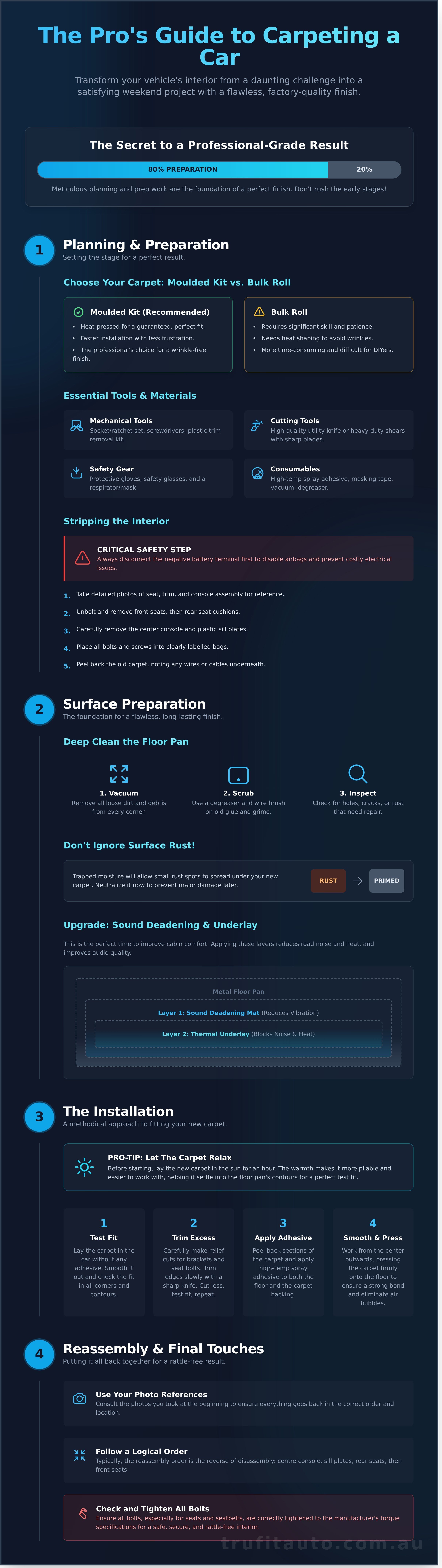
In any automotive project, the final quality is a direct reflection of the preparation that went into it. When it comes to carpeting a car, this is especially true. We estimate that 80% of a professional-grade result comes from meticulous planning and prep work done before the new carpet is even unrolled. Before you remove a single bolt, grab your phone and take plenty of photos of how seats, trim, and the centre console are assembled. These images will be an invaluable reference during reassembly.
Your first major decision is the type of carpet to use. A pre-moulded kit is heat-pressed to the exact contours of your vehicle's floor pan, making it the superior choice for most DIY installers. This process is what defines the different types of automotive carpet and their specific applications. While a bulk roll may seem cheaper, it requires significant skill, patience, and heat shaping to achieve a wrinkle-free finish. For a faster installation with less frustration and a guaranteed fit, a model-specific moulded kit is the professional's choice.
Having the right tools on hand prevents delays and damage to your vehicle's interior. Gather everything you need before you start the job.
With your tools ready, it's time to remove the old interior. The most critical first step is to disconnect the negative terminal of your car battery. Many modern car seats contain airbags and sensors, and skipping this step can be dangerous and costly. Begin by unbolting and removing the front seats, followed by the rear seat cushions. Next, carefully remove the centre console and any plastic kick panels or sill plates that cover the edges of the old carpet. As you work, place all bolts and screws into labelled bags to simplify reassembly. Peel back the old carpet carefully, paying close attention to any wires or cables running underneath.
A new moulded carpet will only ever look as good as the surface it’s laid on. Taking the time to properly prepare the floor pan is the single most important step for achieving a professional, long-lasting result. This isn't just about cleaning; it's about creating the perfect base for your new interior and is a crucial part of carpeting a car correctly. Rushing this stage is a mistake that will show in the final product.
With the old carpet and seats removed, your first job is a deep clean of the bare metal floor. This ensures your new carpet sits flat and any adhesives bond correctly. Follow these simple steps:
It’s tempting to ignore a few spots of surface rust, but this is a critical error. Moisture can get trapped under the new carpet and underlay, allowing that small patch of rust to spread unseen, silently eating away at your floor pan. Treating it now is a simple job that prevents major headaches later. Just use a wire brush to remove the loose scale, apply a quality rust converter to neutralise it, and finish with a coat of primer or chassis paint for durable, long-term protection.
While the floor is bare, you have the perfect opportunity to significantly upgrade your vehicle’s comfort and acoustics. Sound deadening mats are applied directly to the metal to reduce vibrations and panel resonance, while a layer of thermal underlay on top provides excellent insulation against road noise and heat from the exhaust. The result is a quieter, more comfortable cabin and a richer sound from your audio system. For a complete overview of the process, including how these layers contribute to the final fit, this detailed automotive carpet installation guide offers excellent visual examples. Applying these materials is a straightforward way to elevate your project from a simple replacement to a professional restoration.
Shop our range of automotive soundproofing and underlay.
With a clean and prepared floor pan, you're ready for the most satisfying part of the job. Before you reach for any adhesive, patience is key. A thorough test fit is the single most important step to achieving a professional, factory-finish look.
Pro Tip: If possible, lay your new moulded carpet out in the sun for 30-60 minutes before installation. The warmth will soften the backing, making the carpet more pliable and easier to work into the contours of your vehicle's floor.
This is where the value of a high-quality moulded kit becomes clear. Unlike flat carpet, our Tru-Fit moulded kits are designed to match your vehicle's specific floor pan. Start by laying the carpet inside the car without any adhesive. Centre the highest point, typically the transmission tunnel, and smooth the material outwards towards the doors. Let the pre-formed shape guide you. As you work, you may need to make small relief cuts with a sharp utility knife for seatbelt mounts, brackets, or gear shifters. For a great visual walkthrough, this classic car carpet installation video from Hagerty provides excellent guidance. Once you're happy with the fit, apply a light spray of contact adhesive only to the outer edges, the transmission tunnel, and any deep contours to hold it securely in place.
The details separate a good job from a great one. To avoid messy cuts and achieve a clean finish, follow these professional techniques:
For restorers seeking a custom solution, bulk carpet is an option, but it requires significantly more skill. The process involves establishing a centre line in the vehicle and laying the carpet along it, working outwards. A heat gun is essential to carefully warm and stretch the material to conform to the floor's contours without creating wrinkles. This method of carpeting a car demands patience and expertise, illustrating why a pre-moulded kit is the superior choice for the vast majority of DIY installers, saving you hours of frustration.
You’ve reached the final stage. The new carpet is moulded to the floor pan, and your car's interior is already looking transformed. Now, it's time for a careful and methodical reassembly to complete the job to a professional standard. Taking your time here ensures all components fit perfectly and function as they should.
Follow a logical "outside-in" order for reassembly. Begin by reinstalling the plastic sill plates and any side kick panels. These pieces are designed to overlap and secure the edges of your new carpet, giving it a clean, factory-finish look. Next, carefully position the centre console. Before bolting it down, double-check that all electrical connectors for your gear shifter, power outlets, and other controls are securely reconnected. The seats go in last. As you position them over the bolt holes, be sure to reconnect any wiring harnesses underneath, especially the critical seatbelt pre-tensioner wires.
Safety is paramount after a job like this. Before you consider the project complete, perform these essential checks. This is the most important part of the entire process of carpeting a car.
Your hard work deserves to be protected. To maintain that fresh look, we highly recommend investing in a set of quality, custom-fit floor mats. They trap dirt and moisture, making cleaning much easier and preserving the carpet beneath. For any accidental spills, blot the area immediately with a clean cloth-don't rub. To complete the job, give the entire floor one last thorough vacuum to lift the carpet pile and remove any loose fibres from the installation. This final touch makes all the difference.
Now, step back and admire your work. You've successfully completed a project that completely revitalises a vehicle's interior. The professional result is a testament to your careful preparation and attention to detail. Enjoy the fresh look and feel of your renewed cabin. For any future interior needs, from moulded carpets to underfelt, Tru-Fit has the quality parts backed by over 40 years of manufacturing experience.
You now have the complete roadmap for carpeting a car like a seasoned professional. As you've learned, the secret to a flawless result lies not just in the final installation, but in meticulous surface preparation and careful planning. Taking your time with each step ensures your new interior will look and feel like it just rolled off the factory floor, giving you a finish you can be proud of for years to come.
For a job that truly lasts, starting with the right materials is paramount. At Tru-Fit, we put over 40+ years of Australian manufacturing experience into every product. Our carpets are precision moulded for a perfect fit, taking the guesswork out of your installation and guaranteeing a professional finish every time.
Ready for a factory finish? Explore our Tru-Fit Moulded Carpets. With our reliable Australia-wide delivery, the perfect foundation for your project is just a click away.
Now, grab your tools and get ready to transform your vehicle’s interior. You've got this!
We strongly advise against this. Laying new carpet over the old will result in a poor fit, as our moulded carpets are designed for the bare floor pan. More importantly, old carpets can trap moisture, dirt, and mould, which will lead to rust and unpleasant odours in your vehicle. For a professional, long-lasting result, always remove the old carpet and thoroughly clean the floor pan before installing your new Tru-Fit kit.
The cost of carpeting a car yourself can vary. A complete moulded carpet kit for a standard sedan or ute typically ranges from A$200 to A$400. The final price depends on the vehicle's make and model, and whether you choose a standard loop pile or a premium plush pile. Additional materials like spray adhesive and sound deadening will add a modest amount to the total project cost, but it remains a highly cost-effective DIY project.
While not strictly mandatory, we highly recommend installing both for a professional finish. Sound deadening material reduces road noise and vibrations, creating a quieter cabin. The underlay provides thermal insulation and a plusher feel underfoot, preventing the carpet from showing any floor pan imperfections. Skipping these steps can result in a less comfortable and noisier driving experience, so it is a worthwhile investment for the best possible outcome.
For a first-time installer, the entire process typically takes between four to six hours. This includes removing seats and old trim, cleaning the floor pan, fitting the new carpet, and reinstalling all components. An experienced professional might complete the job in three to four hours. We recommend setting aside a full afternoon to ensure you can work carefully and not rush any of the critical steps for a perfect fit.
We recommend using a high-temperature contact spray adhesive, specifically formulated for automotive upholstery. Standard craft glues or general-purpose sprays will not withstand the temperature fluctuations inside a vehicle and can fail over time. A quality contact adhesive ensures a strong, permanent bond on vertical surfaces and along the edges. Always follow the manufacturer's instructions, typically applying a light coat to both the floor pan and the carpet backing.
The best method is prevention. Allow your new moulded carpet to sit unrolled in a warm, sunny spot for a few hours before installation to help it relax into its shape. During fitting, start from the centre of the vehicle and work outwards, smoothing the material as you go. For any stubborn wrinkles that remain, a gentle application of heat from a heat gun or hairdryer will make the carpet more pliable and easier to smooth into place.
 To Order Free Call 1800 335 896
 Cart
Cart


