Please fill in the fields to search in more detail.
Is the constant drone of road noise on the highway turning your drive into a headache? Or maybe you’re tired of feeling the heat from the engine and exhaust radiating through the floor, making long trips in the Aussie sun uncomfortable. These common issues, along with the disappointment of a new carpet feeling thin and cheap, can often be traced back to one crucial, yet overlooked, component. A high-quality automotive flooring carpet underlay is the key to achieving a truly premium cabin experience, protecting your investment and transforming how your vehicle feels on the road.
With over 40 years of experience in automotive manufacturing, we know what works. This guide will help you understand the different types of underlay-from traditional jute to modern multi-layer composites. You'll discover how to choose the perfect one for your vehicle to quieten your ride, improve insulation against heat, prevent moisture that can lead to rust, and finally give your new carpet that plush, comfortable feel it deserves.
When replacing your vehicle's carpet, it’s easy to focus solely on the top layer. However, what lies beneath is just as important. Automotive carpet underlay is the purpose-built material that sits between your car's metal floor pan and the moulded carpet. It’s far more than just padding; it's a critical component of your vehicle's interior system. Thinking of it as an optional extra is a common mistake. In reality, a quality flooring carpet underlay is essential for managing the harsh and demanding environment inside a vehicle-an environment far more extreme than any room in your house, with constant vibration, heat, and noise.
A high-quality underlay performs three distinct jobs simultaneously to improve your driving experience and protect your investment:
While it might be tempting to use a household carpet offcut, it's a poor and often damaging substitute. Automotive-grade flooring carpet underlay is specifically engineered to withstand conditions that household products simply cannot handle. Key differences include its superior heat resistance to cope with high temperatures from the drivetrain, its moisture and mould-resistant properties to prevent rust from forming on the floor pan, and its design to help dampen the low-frequency vibrations that travel through a vehicle's body panels. Using the wrong material can lead to foul odours, rust, and rapid deterioration.
Choosing the right flooring carpet underlay is about more than just padding beneath your feet. The material you select directly impacts your vehicle's thermal insulation, moisture resistance, and cabin noise. Here in Australia, with our diverse driving conditions, understanding the primary options is key to making a smart investment for your car, 4x4, or classic restoration project. Let's break down the most common materials available.
Jute underlay is a traditional, fibrous material made from natural plant fibres. It's often the original material found in classic vehicles, making it a popular choice for restorers seeking an authentic finish. While it provides good insulation, its main drawback is its tendency to absorb and hold water.
Ethylene-vinyl acetate (EVA) is a modern, closed-cell foam that is lightweight, durable, and versatile. Unlike jute, its closed-cell structure means it cannot absorb water, making it an excellent moisture barrier. It has become the standard for most modern applications due to its balanced performance.
These are specialist materials designed for maximum noise reduction. Butyl rubber is a self-adhesive sheet applied directly to metal panels to stop vibrations, while Mass Loaded Vinyl (MLV) is a heavy, dense vinyl barrier laid over the floor to block airborne sound waves. The effectiveness of dense materials is well-documented, with scientific research into the acoustic properties of recycled materials demonstrating how mass directly impacts sound transmission loss. These products are typically used as a first layer, with a foam or jute underlay installed on top.
These are advanced composite products that combine the benefits of several materials into a single sheet. Typically, they feature a foam or fibrous core bonded to a reinforced foil facing. This construction offers a comprehensive solution for both heat and sound management.
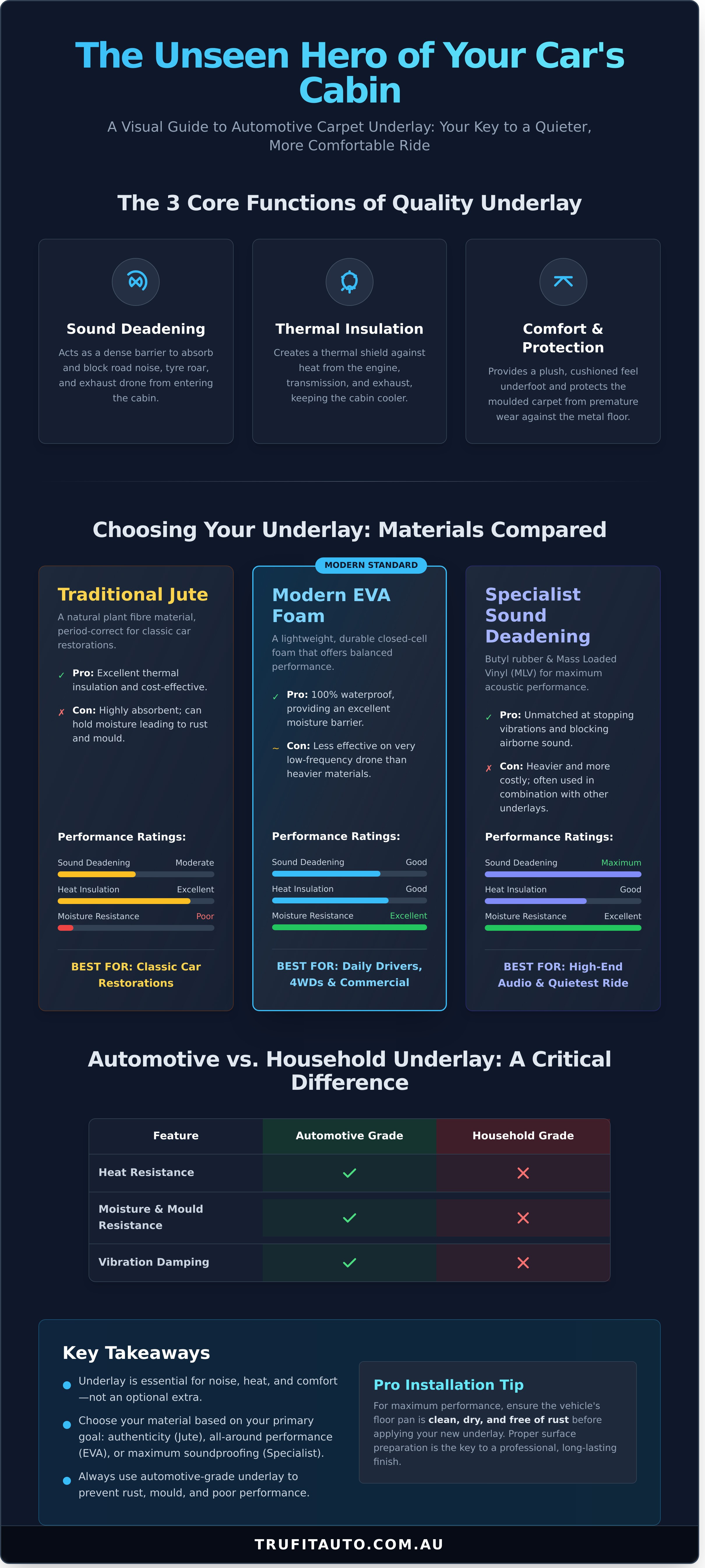
Selecting the right underlay is not a one-size-fits-all decision. The best choice depends entirely on your vehicle and what you want to achieve. Are you aiming for period-correct authenticity, rugged durability, or the quietest possible cabin? By identifying your main goal, you can easily choose the perfect flooring carpet underlay to match your project's needs and get the most value from your investment.
Goal: Authenticity with improved comfort.
For a true restoration project, nothing beats the original look and feel of traditional Jute underlay. It provides moderate sound and heat insulation while remaining true to the vehicle's factory specifications. If you desire better performance without compromising appearance, modern composite materials are available that mimic the original jute but offer enhanced acoustic properties for a more comfortable ride.
Goal: Durability, water resistance, and noise reduction.
Off-road vehicles face harsh conditions, from muddy tracks to river crossings. A waterproof, closed-cell EVA Foam underlay is the top choice here. It won't absorb water, preventing the growth of mould and mildew that can ruin an interior. For the ultimate hard-wearing solution, we recommend pairing it with our moulded vinyl flooring for an interior that’s easy to clean and built to last.
Goal: A quieter, more comfortable commute.
For the car you drive every day, the priority is balance. A quality multi-layer thermal acoustic underlay provides the best of both worlds, significantly reducing road noise and insulating against heat from the engine and transmission tunnel. As shown in a comprehensive sound absorbing material survey by automotive engineers, layered composites outperform single-material solutions, making your daily drive more serene and comfortable.
Goal: Maximum sound deadening for a clean audio experience.
To achieve a pristine audio environment, you must eliminate panel vibration and block external noise. This requires a multi-stage approach. First, apply a Butyl-based sound deadener directly to the floor pan to stop resonance. Then, layer a high-density product like Mass Loaded Vinyl (MLV) or EVA foam on top. This combination creates a solid, acoustically dead cabin, ensuring you hear your music-and only your music.
Achieving a factory-quality finish when installing automotive underlay is well within reach for the dedicated DIY enthusiast. The secret isn't a workshop full of expensive tools; it’s patience and proper preparation. Taking the time to do the groundwork correctly will make the final carpet installation smoother and ensure your new underlay performs at its best for years to come.
Your new underlay needs a clean, solid foundation. Start by completely removing the old carpet, underlay, and any residual glue or debris. A scraper and solvent can help with stubborn adhesive. Inspect the bare metal floor pan thoroughly. Address any surface rust with a wire brush or wheel, then treat it with a rust converter and a coat of primer or paint to prevent future corrosion. The surface must be completely clean and dry before you proceed.
The most accurate way to cut your new material is to use the old underlay or carpet as a template. Lay it over your new flooring carpet underlay and trace the outline with a marker. If the old material is unusable, you can create new templates from cardboard. Always use a sharp utility knife for clean, precise cuts. Before cutting, lay out your pieces to plan the most efficient use of the material, minimising waste and the number of seams.
In most cases, a spray adhesive isn't necessary for the entire floor, as the weight of the moulded carpet will hold the underlay in place. However, a light mist of contact adhesive is useful for securing pieces on vertical surfaces like the firewall or high on the transmission tunnel. Ensure every piece sits perfectly flat without bumps or creases. For complex curves, make small relief cuts to allow the material to conform to the contours of the floor pan without bunching up.
With over 40 years of experience, we’ve seen a few common pitfalls. Avoid these simple errors to guarantee a better result:
Ready to get started? Find the right underlay for your project in our online store.
Choosing the right underlay is more than a finishing touch; it’s a fundamental upgrade for your vehicle's comfort and protection. As we've covered, the correct material provides essential heat and sound insulation, while a proper installation ensures a professional result. Investing in a quality flooring carpet underlay is a crucial step that ensures your vehicle's interior not only looks pristine but also feels significantly quieter and more comfortable on Australian roads.
Don't settle for less than the best for your vehicle. As an Australian manufacturer with over 40 years of experience, Tru-Fit provides expert advice and high-performance materials for classic cars, rugged 4x4s, and daily drivers alike. Our commitment to quality means you get superior sound and heat insulation engineered for local conditions.
Ready to feel the difference a premium underlay can make? Explore Tru-Fit's range of Australian-made underlay and insulation and give your project the professional finish it truly deserves.
Yes, layering is an excellent strategy for superior results. For the ultimate acoustic and thermal barrier, we recommend first applying a sound deadening mat directly to the vehicle's floor pan. This reduces vibrations and panel resonance. Then, install a traditional flooring carpet underlay, like our jute or foam products, over the top to absorb airborne noise and provide thermal insulation. This combination offers the best of both worlds for a quiet, comfortable cabin.
The required amount varies depending on the size of your vehicle. A standard sedan or ute cabin will typically need around 3.5 to 4 square metres to cover the floor pan. For a larger 4WD, wagon or van, you should plan for 5 to 6 square metres. We always recommend measuring your specific area and adding about 10% extra to account for cuts and contours. If you are unsure, talk to our team for model-specific advice.
We strongly recommend it. While moulded vinyl is extremely durable and easy to clean, it provides very little thermal or acoustic insulation on its own. Installing a quality flooring carpet underlay beneath the vinyl is crucial for blocking road noise and heat from the transmission tunnel. It also provides a more solid, premium feel underfoot and ensures a professional finish, preventing the vinyl from feeling thin or flimsy over the metal floor.
It is generally not advisable to reuse old underlay. After years of use, the original material becomes heavily compressed, losing most of its insulating and sound-absorbing properties. More importantly, old underlay often harbours moisture, which can lead to mould, mildew, and persistent musty odours. For the best performance and a clean, fresh-smelling interior, always start with new, high-quality underlay material during your restoration.
A sharp utility knife, or Stanley knife, with a new blade is the most effective tool for cutting thick underlay. For the best results, place the material on a safe cutting surface like a piece of scrap plywood. Use your old carpet or a cardboard template to trace your pattern. Apply firm, steady pressure and make several shallow passes with the knife rather than trying to cut through in one go. This gives you greater control and a cleaner edge.
Yes, in most cases, this is the definitive solution. That persistent musty smell is typically caused by moisture trapped in the original underlay and carpet fibres, leading to mould and mildew growth. Simply cleaning the surface won't eliminate the source. Completely removing the old materials and installing a new, dry flooring carpet underlay and moulded carpet is the most effective way to permanently eradicate the odour and restore a fresh cabin environment.
 To Order Free Call 1800 335 896
 Cart
Cart


