Please fill in the fields to search in more detail.
The classic lines of the ford falcon xw wagon are unmistakable, but bringing one of these Australian icons back to its former glory presents a unique set of challenges. If you've ever struggled to find reliable, model-specific information, tried to decipher the key differences between a Falcon 500 and a Fairmont, or felt the frustration of sourcing correct-fitting parts for that expansive interior, you're in the right place. This guide is your definitive resource, designed to cut through the noise and provide the clear, practical advice you need for your project.
We will walk you through the history and key specifications, helping you confidently identify different models and their unique features. You'll learn the common problem areas to inspect before you buy and discover essential tips for your restoration journey. With a special focus on bringing that iconic interior back to its original condition using parts that fit right the first time, you'll feel equipped and inspired to get your classic wagon on the road. Let's get started.
Stepping onto the Australian automotive scene in 1969, the Ford XW Falcon marked a significant departure from its predecessors. For its brief but impactful production run until 1970, the XW series brought a bold, American-inspired "Mustang-bred" design philosophy Down Under. This new direction introduced an aggressive and muscular look that resonated strongly with the public, moving the Falcon family from a conservative family car to a genuine V8-powered style icon.
While the GT-HO performance sedans often steal the limelight, the wagon variant was the unsung hero for countless Australian families and tradespeople. The XW wagon perfectly blended this exciting new styling with the practicality and durability that owners demanded, cementing its place as a cornerstone of Australian automotive history.
The visual leap from the preceding XT model to the XW was dramatic. Ford's designers replaced the XT's flat face with a deeply recessed, split grille that gave the car a more aggressive, shark-like presence. The rear was updated with sleek, rectangular tail lights, while the body featured more pronounced "coke-bottle" lines, especially over the rear wheels, enhancing its muscular stance. Inside, the changes were just as significant, with a new dashboard design that focused on safety and ergonomics, featuring recessed instruments and improved switchgear.
In the early 1970s, the ford falcon xw wagon was a quintessential part of the Australian landscape. It was the trusted vehicle for family road trips, loaded with luggage and kids for the annual holiday, and the dependable workhorse for tradies during the week. It stood as a direct and fierce competitor to the Holden HT Kingswood wagon, defining one of Australia's greatest automotive rivalries. Its enduring appeal for classic car enthusiasts today stems from this perfect blend of V8 performance potential, practical utility, and a powerful sense of nostalgia. The model's extensive specifications and production history are well-documented on the Ford Falcon (XW) Wikipedia page, showcasing why it remains a celebrated classic.
The Ford XW series, running from 1969 to 1970, represented a bold new direction for the Falcon, boasting aggressive "Mustang-bred" styling and a serious performance focus. This era is often regarded as a golden age of Australian motoring, a history expertly preserved by institutions like the National Motor Museum. For the practical station wagon, this meant an unprecedented level of choice, allowing buyers to configure their vehicle as anything from a basic family hauler to a V8-powered cruiser with genuine muscle.
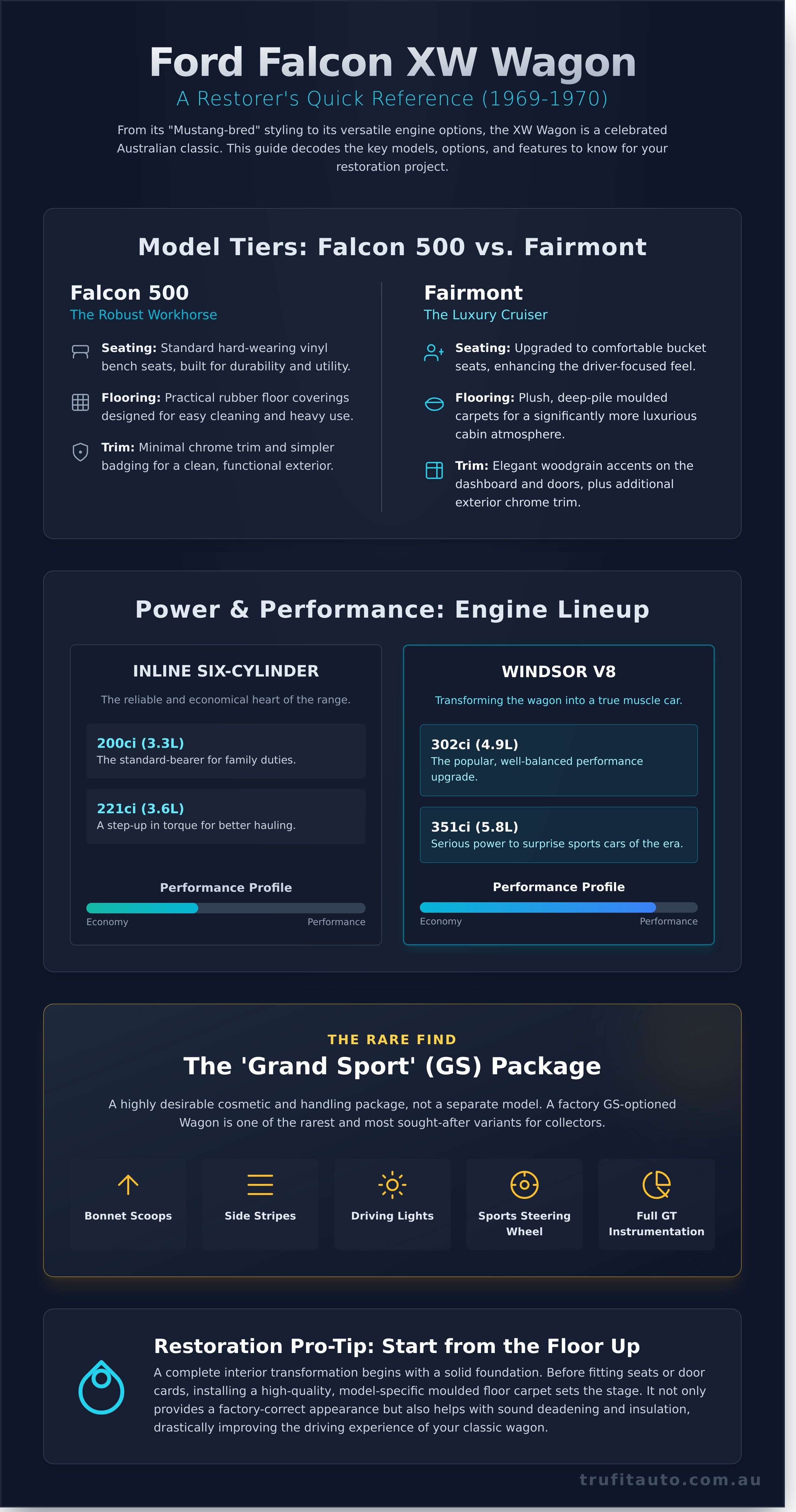
The XW wagon lineup was primarily split between two distinct trim levels. The Falcon 500 served as the robust, entry-level workhorse. It came standard with hard-wearing vinyl bench seats, practical rubber floor coverings, and essential instrumentation, designed for durability and ease of maintenance. For those seeking more comfort, the Fairmont model offered significant upgrades. It featured plush, deep-pile moulded carpets, elegant woodgrain accents on the dashboard and doors, and often came with bucket seats, transforming the cabin into a far more luxurious space. Externally, the Fairmont was set apart by additional chrome trim, unique badging, and a more detailed grille.
A major drawcard for the XW range was its versatile engine and transmission selection. This allowed the ford falcon xw wagon to be tailored for either economy or outright performance.
These engines were typically paired with either a three-on-the-tree manual transmission or the far more common three-speed Cruise-O-Matic automatic.
One of the most desirable factory options was the 'Grand Sport' (GS) package. Crucially, this was a cosmetic and handling package, not a separate model. Ticking the GS box added a host of sporty features, including bonnet scoops, bold side stripes, grille-mounted driving lights, a unique sports steering wheel, and full GT-style instrumentation with a tachometer. While common on sedans, a factory-optioned GS wagon is a truly rare find today, representing the ultimate combination of practicality and period-correct performance styling.
Finding a solid Ford Falcon XW wagon today requires a sharp eye and a methodical approach. These classic workhorses have often lived hard lives, but a thorough inspection can help you distinguish a well-preserved survivor from a project that requires extensive work. This guide provides a practical checklist to help you assess a potential purchase with confidence.
For any car from this era, the body's condition is paramount. Rust is the biggest enemy, and repairs can quickly become expensive. Bring a torch and a small magnet to your inspection. For a visual reference of what to look for in a top-condition vehicle, the Shannons Club XW Falcon video offers excellent details on panel fit and finish. Pay close attention to these common problem areas:
Check for signs of accident damage by looking for uneven panel gaps, paint overspray on trim, and ripples in the bodywork. Use the magnet on lower body sections to detect thick layers of body filler.
While XW Falcons are mechanically robust, decades of use take their toll. Start the engine from cold and listen for any rattles, knocks, or excessive smoke from the exhaust. During a test drive, listen for whines from the transmission or differential. Check for fluid leaks under the car after it has been running. Key components to inspect include:
The interior tells a story of the car's life. Check the condition of the seats, door cards, and headliner for rips, cracks, or sagging, as finding original replacement trim can be challenging. In a wagon, pay special attention to the cargo area floor and side panels for signs of heavy use or water damage. Worn or missing flooring is a very common issue but is one of the easiest to rectify. A high-quality, pre-moulded carpet kit from trufitauto.com.au can completely transform the look and feel of the cabin, providing a perfect finishing touch for your classic wagon.
A pristine exterior will turn heads, but it's a fresh, clean interior that truly transforms the driving experience and elevates a classic car to show-winning status. The foundation of any high-quality interior restoration is the floor. Replacing worn, stained, or faded carpet is the single most effective way to revitalise the cabin, setting the stage for everything else. You can choose between an authentic, hard-wearing loop pile carpet to match the original factory finish, or opt for a more modern, luxurious plush pile for upgraded comfort.
For a perfect, factory-like fit without creases or folds, nothing beats a pre-moulded carpet. These carpets are heat-pressed using moulds taken from original floor pans, ensuring they follow every contour of your Falcon's floor. For vehicles that work as hard as they play, heavy-duty moulded vinyl is an excellent alternative. It offers superior durability and is easy to clean, making it ideal for utes and workhorse wagons. Both options are available in a range of colours to match your original trim or create a new custom look.
Replacing the carpet without installing new underlay is a job half-done. Old underlay degrades, loses its cushioning, and can hold moisture and odours. Fresh, high-quality underlay is crucial for proper carpet fitment and feel. For the ultimate upgrade in comfort, we highly recommend adding a layer of sound deadening material. This is the key to a quieter, more pleasant ride.
The small details make all the difference. New kick panels protect the carpet edges in the footwells and provide a clean, finished appearance. For station wagon owners, the large load area is a critical part of the interior. A tired or damaged cargo mat can let down the entire restoration. We offer matching flooring for the cargo space of models like the Ford Falcon XW Wagon, ensuring a cohesive and complete look from the firewall to the tailgate.
Ready to transform your Falcon's interior from tired to timeless? With over 40 years of experience manufacturing automotive flooring, Tru-Fit Carpets by Vision Auto has the quality parts you need. Explore our Ford Falcon flooring options from Tru-Fit Carpets by Vision Auto.
The Ford Falcon XW Wagon is more than just a classic car; it's a cherished piece of Australian motoring history. From understanding its unique models to conducting a thorough inspection, every step you take honours its heritage. As we've covered, a meticulously restored interior is often what separates a good project from a truly show-winning masterpiece, making it a critical focus for any serious restorer.
Whether you're preserving a family heirloom or building the ultimate weekend cruiser, investing in quality components for your ford falcon xw wagon is crucial for a lasting and authentic result. The foundation of any great interior starts from the floor up. With over 40 years of manufacturing experience, Tru-Fit Auto delivers Australian-made products designed for a perfect fit, ensuring your project meets the highest standards. Get the expert advice your restoration deserves.
Ready to transform your cabin? Find Australian-made moulded carpet for your Ford Falcon XW Wagon here.
Your classic Falcon deserves the best. Happy restoring!
The value of a Ford Falcon XW Wagon in Australia varies significantly based on its condition. A project car needing full restoration might sell for A$5,000 - A$15,000. A tidy, running survivor or older restoration typically ranges from A$25,000 to A$45,000. Exceptional, concours-level examples, especially V8 Fairmont models, can command prices exceeding A$60,000. Originality, engine type, and trim level are the key factors that determine the final price.
No, Ford Australia never produced a genuine XW Falcon GT wagon from the factory. While the idea was popular and some dealers created their own versions, all official GT and GT-HO models were sedans. Any XW wagon you see with GT styling, such as the iconic shaker hood scoop and stripes, is a tribute or replica. These "what if" builds are a popular part of Falcon enthusiast culture, but they are not factory-original vehicles.
The most noticeable difference between an XW and an XY Falcon wagon is the front grille and rear taillights. The XW features a split-centre grille, whereas the XY has a cleaner, single-piece plastic grille. At the rear, XW wagons have flat, rectangular taillights, while the XY's lights have a more pronounced, curved profile that wraps slightly around the body. The XY also introduced the improved 250-2V six-cylinder engine as a more common option.
Finding restoration parts for an XW wagon in Australia is generally manageable, but with some challenges. Mechanical components and front-end body panels are widely available as they are shared with the more common sedan. However, wagon-specific parts like tailgate hardware, rear quarter glass, and long roof-lining bows can be difficult to source. Specialist suppliers and classic Ford wrecking yards are your best bet for these unique items, which often command a premium.
Yes, installing a new moulded car carpet is a very achievable DIY project for most enthusiasts. The process involves removing the seats, console, and lower door trims to access the floor pan. After removing the old carpet and thoroughly cleaning the surface, you lay the new moulded carpet in place. It will require some minor trimming around the edges and shifter holes for a perfect fit before you reinstall all the interior components. Patience is key.
For reliable modern driving in a Ford Falcon XW wagon, the original 250ci six-cylinder is a fantastic, period-correct choice offering adequate power. However, for those wanting more performance and a classic V8 sound, a 302 or 351 Windsor V8 is the most popular and well-supported engine swap. This conversion provides a significant power increase, making highway cruising and towing much easier, and parts are readily available throughout Australia for these engines.
 To Order Free Call 1800 335 896
 Cart
Cart


