Please fill in the fields to search in more detail.
A flawless paint job and a rebuilt engine won't save a classic restoration if the floor looks like it belongs in a modern office. You've likely spent hours staring at a sun-bleached scrap of fabric, worried that a new kit will look "cheap" or "off-period" compared to the factory original. Getting the tactile details right is what separates a basic refurbishment from a true, high-value restoration. We understand that matching original car carpet texture is often the most difficult part of an interior rebuild, especially when original materials are missing or degraded.
You want an interior that honours your vehicle's heritage while handling the harsh Australian climate. You're going to learn how to identify specific pile variations, from the classic loops of the 1960s and 1970s to the denser plush piles found in luxury models. This guide covers everything from technical texture identification to sourcing the right moulded carpet flooring for a factory-perfect finish. We'll help you navigate the differences between various piles so you can increase your vehicle's resale value and finish your project with total confidence.
Restoring a vehicle to its former glory requires more than just fresh paint and a tuned engine. True enthusiasts know that the interior defines the driving experience. If the flooring texture is wrong, the entire cabin feels mismatched. Generic, one-size-fits-all carpets often lack the specific density or weave found in factory originals. They fail to capture the original manufacturing intent, leaving the car looking like a modern imitation rather than a preserved piece of history. Achieving a period-correct finish depends heavily on matching original car carpet texture to the specific era of the vehicle.
High-quality restoration projects focus on these tactile details because they signal a commitment to quality. When a restorer chooses a texture that clashes with the vehicle's production date, it breaks the immersion. A 1965 Mustang with 1990s-style plush pile looks out of place. This visual disconnect tells potential buyers that corners were cut during the build. Using authentic materials ensures every component works together to recreate the factory atmosphere.
The stakes are high for collectors and judges at automotive shows. A "near enough is good enough" approach can significantly lower a vehicle's market value. Professional restorers look for specific pile patterns because they serve as a visual cue of authenticity. Molded carpet technology allowed manufacturers to create precise floor contours, but it was the texture that defined the interior's class. Buyers will pay a premium for a car that feels exactly as it did on the showroom floor decades ago. Period-correct texture is the fingerprint of a car’s era.
Texture isn't just about aesthetics; it serves a functional purpose. During the 1960s and 70s, many Australian workhorses used loop pile for its extreme durability. It handled the grit and grime of daily use without fraying. By the 1980s, the industry shifted toward plush cut piles. This change wasn't just for style. Denser cut piles provided better natural sound dampening and a more luxurious feel. When you focus on matching original car carpet texture, you ensure the flooring integrates perfectly with original automotive soundproofing underlay. This creates a seamless fit that prevents cabin noise and maintains the intended acoustic profile of the vintage vehicle. Using the wrong pile height can also lead to issues with kick panels and parcel shelves not sitting flush.
Understanding the technical shift between different flooring styles is essential for anyone serious about matching original car carpet texture. Automotive manufacturers selected materials based on the production technology of the day. The evolution of automotive interior fabrics shows a clear progression from rugged, functional loops to the luxurious, plush finishes of the modern era. Knowing which category your vehicle falls into prevents the mistake of installing a 1980s-style carpet in a 1960s classic.
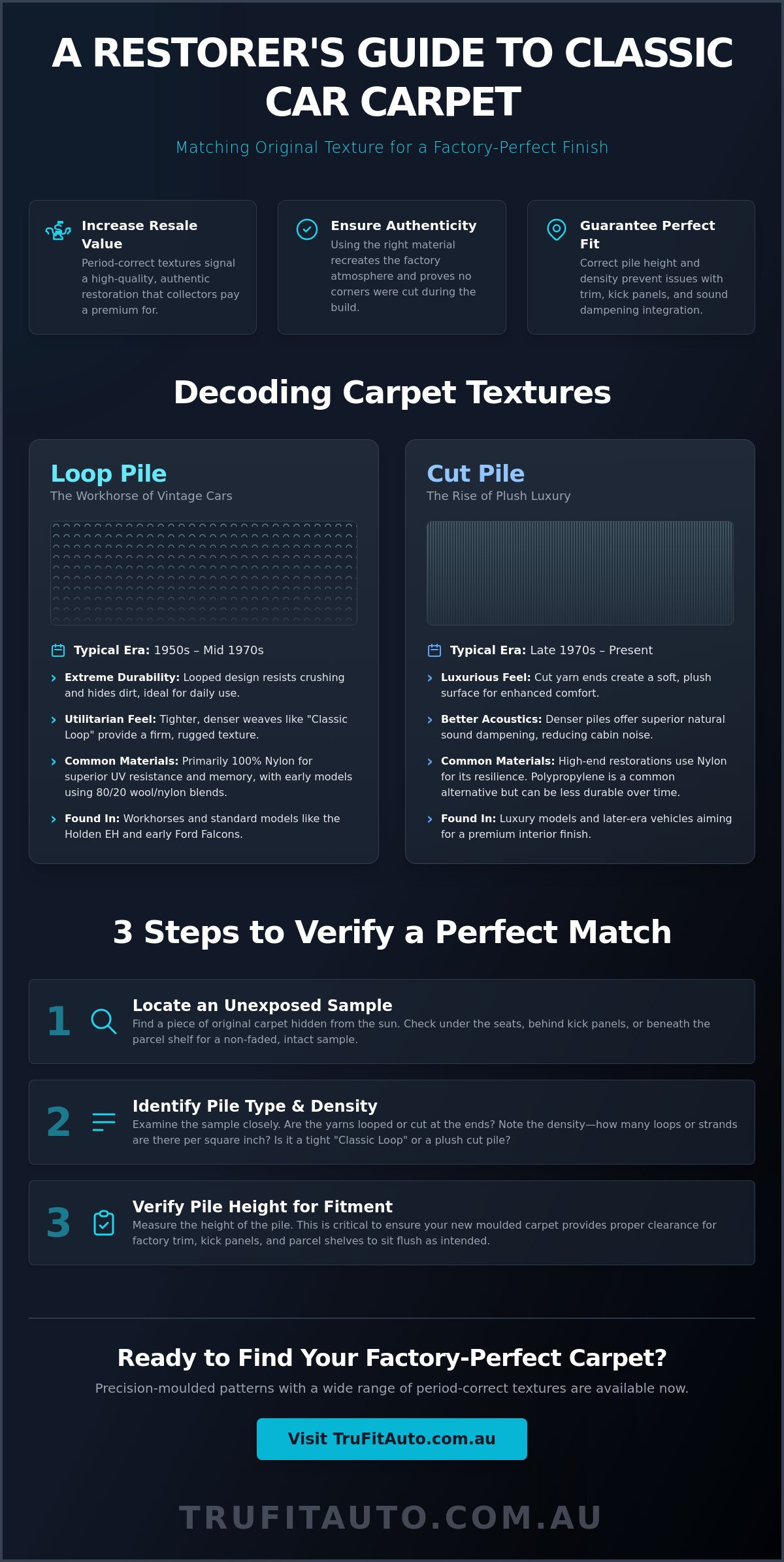
From the 1950s through to the mid-1970s, loop pile was the industry standard. It consists of yarn that is pulled through the backing and left as a continuous loop. This design offers incredible durability. It resists crushing under heavy foot traffic. Early Australian vehicles, like the Holden EH or the Ford Falcon XM, relied on this texture to withstand the tough local environment. Nylon remains the preferred material for high-end restoration because of its superior UV resistance and memory. It holds its shape better than polypropylene, which can become brittle and lose its colour after years of exposure to the Australian sun.
When examining a degraded sample, look for the "Classic Loop" signature. This is a much tighter, denser weave than the standard loop pile found in later, more budget-oriented models. While many early cars used an 80/20 wool and nylon blend, 100% nylon loop became the dominant choice for its resilience. Identifying "tight loop" versus "standard loop" requires looking at the number of loops per square inch. A tighter weave provides a firmer feel and was often used in utility-focused vehicles to prevent dirt from becoming trapped deep in the fibres.
As the late 1970s approached, consumer tastes shifted toward comfort. This led to the rise of cut pile, often called plush pile. In this style, the loops are cut at the top, creating a soft, velvet-like surface. This became the luxury standard for the Commodore and Falcon EFI eras. It provided a significant upgrade in cabin feel and sound insulation. While loop pile is more resilient, cut pile offers a level of comfort that defined the "executive" feel of the 1980s.
Pile height is a critical technical factor here. If the pile is too high, seat tracks may bind, and original trim clips might fail to engage. Matching original car carpet texture exactly ensures that your seats and consoles sit at the correct factory height. For those seeking a period-correct finish, viewing a range of moulded carpet flooring samples can help identify the exact density required for your specific model year. This attention to detail ensures your interior components fit as the manufacturer intended.
Australian automotive history is defined by a specific set of textures that reflect the era's manufacturing capabilities. When you're matching original car carpet texture for a local icon, you can't rely on global standards. A Holden Kingswood requires a vastly different pile density than a Ford Falcon GTHO, even if they were produced in the same decade. Understanding these nuances is the only way to achieve a factory-correct result. Generic kits often miss the subtle differences in weave that define these legendary cabins.
For Chrysler Valiant enthusiasts, the challenge often lies in the distinct loop patterns found in the Charger and Pacer. These vehicles used a specific weave that generic manufacturers rarely replicate accurately. Similarly, restorers of classic LandCruisers and Patrols often move away from carpet entirely. In these rugged 4x4s, durability is the priority. Choosing high-quality moulded vinyl flooring provides the original utilitarian look while making the cabin much easier to clean after a trip into the bush. It's about selecting a material that matches the vehicle's original purpose.
Early 1960s Holden models often featured a unique "salt and pepper" look. This was a multi-toned loop pile that gave the interior a textured, hard-wearing finish. It was designed to hide dirt while providing a resilient surface for family use. By the time the WB Statesman and the VK/VL Commodores arrived, the brand had shifted toward a more premium cut pile. This transition marked a move toward executive comfort and better sound insulation. If you're working on a more recent classic, our Holden WH Statesman restoration guide provides excellent context for matching modern-classic textures in a luxury setting.
Ford's X-series lineage, particularly the XW, XY, and XA series, utilized "tufted" textures that are notoriously difficult to match. The iconic GT and GTHO models required a very specific loop height to clear the floor-mounted shifters and original trim components. Getting this wrong results in a carpet that bunches or fails to sit flat against the transmission tunnel. For those working on earlier utility models, the Ford Falcon XP Wagon moulded carpet serves as a perfect case study in how a correctly shaped and textured floor can transform a cabin. Matching the original density ensures that your kick panels and seat tracks fit without modification.
Buying a carpet kit based on a low-resolution thumbnail is a gamble that rarely pays off for serious restorers. Digital screens often distort colours and hide the true density of the pile. To achieve a factory-correct finish, you need a physical verification process. This ensures you are matching original car carpet texture accurately before committing to a full set of moulded carpet flooring. Taking the time to verify these details prevents the frustration of an interior that looks modern or cheap compared to the rest of your build.
Step 1 involves the "Unexposed Sample" test. Most classic cars have sections of carpet that haven't seen the sun or a boot sole in decades. Look under the rear seat bench or behind the kick panels. These areas preserve the original colour and pile height. Step 2 requires a pile height and density check. Use a ruler to measure the thickness of your original sample and compare it to the replacement. If the new pile is too thick, your original trim clips won't reach the sheet metal and your seat tracks might bind. Step 3 is the light test. Take your samples outside into the Australian sun. Different textures reflect light in unique ways; a loop pile might look correct in a garage but appear too shiny or dull under direct sunlight.
A perfect texture match is useless if the carpet doesn't follow the floor's contours. Choosing a moulded product is just as important as the texture itself. Pre-moulded kits are engineered to fit the specific floor pan of your vehicle, ensuring the pile doesn't stretch or distort over transmission tunnels. This structural accuracy ensures the texture remains consistent across the entire floor surface without unsightly bunching.
Start your search in areas protected from foot traffic and UV rays. The space under the centre console or the very top edge of the firewall are prime locations for finding non-faded carpet sections. Once you find a piece, use a soft brush and a mild vacuum to remove decades of accumulated dust. This reveals the true original texture and shade. When photographing your sample for expert matching, use natural, indirect light and include a ruler or a coin to provide a clear sense of scale for the pile density.
Never rely on a digital screen for texture or colour matching. Request physical swatches from your supplier so you can touch the material. Perform a "rub test" by firmly rubbing the pile with your thumb to check for shedding or poor fibre retention. High-quality nylon should bounce back immediately. Also, examine the backing of the swatch. A critical factor for DIY installation is the mouldable layer. This allows the carpet to retain the shape of your floor pan once heat is applied during the fitting process. If you're ready to see the quality of our materials firsthand, you can request a texture swatch to begin your verification process.
Tru-Fit Automotive has been a cornerstone of the Australian vehicle restoration community for over 30 years. We understand that a factory-perfect finish requires more than just a piece of fabric that fits the floor. It demands a deep understanding of how textures evolved across decades of local manufacturing. Our facility in Pakenham produces moulded carpet flooring specifically engineered to withstand the extreme UV levels and heat of the Australian climate. This local expertise ensures your interior doesn't just look original on day one but maintains its integrity for years to come.
Our material range is designed to eliminate the guesswork involved in matching original car carpet texture. Whether you're chasing the utilitarian tight loop of a 1960s workhorse or the plush, executive cut pile of a 1980s luxury sedan, we maintain an extensive inventory of period-correct materials. We use custom moulding technology that ensures the texture stays uniform across every hump and dip in your floor pan. Unlike generic kits that can stretch and distort the pile over the transmission tunnel, our moulds preserve the original density and weave of the material across the entire surface.
Finding the right material for a rare or limited-edition model can be a major hurdle for many enthusiasts. Our team uses historical archives and decades of pattern data to recommend the exact texture required for your vehicle's era. If we have the mould in our library of hundreds of Australian and international patterns, we can match the texture to ensure a seamless result. This technical support is vital for high-end builds where judging accuracy is a priority. You can get a custom quote for your vehicle restoration today to see how we can assist with your specific project requirements.
A truly period-correct interior requires a cohesive look across all surfaces. Once you've secured the correct floor texture, it's essential to pair it with matching kick panels and parcel shelves. These components often use similar or complementary textures that tie the cabin together. We also emphasize the importance of high-quality automotive soundproofing underlay. This doesn't just reduce cabin noise; it provides the structural firmness that gives the carpet its "new car" feel underfoot. To find everything you need for your interior rebuild, browse our full range of moulded flooring and restoration accessories and take the final step toward a factory-perfect finish.
Completing a high-quality restoration requires a commitment to the smallest tactile details. We've explored the technical shift from vintage loop piles to executive cut piles and provided a clear verification process for sourcing authentic materials. Choosing the right density and weave ensures your cabin remains period-correct while protecting the vehicle's long-term market value. Matching original car carpet texture is the essential final step in creating an interior that feels truly authentic rather than just refurbished.
Tru-Fit Automotive brings more than 30 years of Australian manufacturing heritage to your restoration project. We maintain custom-fit moulds for over 700 vehicle models; all engineered and produced by our Pakenham-based experts to handle local conditions. Our team provides the technical precision needed to avoid the common pitfalls of generic, thin flooring kits. Don't settle for a "near enough" finish when you can have a factory-correct result that honours your car's history.
Find your vehicle and match your original carpet texture today. Your restoration deserves an interior that looks and feels exactly as it did on the showroom floor.
Loop pile uses continuous loops of yarn, whereas cut pile has the loops cut at the top to create a plush, velvet-like surface. Loop pile was the standard for most vehicles until the mid-1970s because of its extreme durability. Cut pile became popular in the 1980s for its luxury feel and superior sound insulation. Both styles serve different aesthetic and functional roles in a period-correct restoration.
Check the vehicle's production year and trim level to determine the original flooring style. Most pre-1975 Australian cars used loop pile, while later executive models shifted to cut pile. You can also look for original sales brochures or historical archives. If you're unsure about matching original car carpet texture, inspecting the back of original kick panels or under the centre console often reveals small remnants of the factory material.
Yes, you can upgrade to cut pile if you prefer a more modern, luxurious feel in your cabin. However, this will move the vehicle away from a period-correct status, which might affect its value at car shows or in the collector market. If you choose to switch, ensure the new pile height doesn't interfere with seat tracks or original trim fitment. We recommend sticking to the factory specifications for high-value restorations.
Loop pile is generally more resistant to crushing but can trap dirt deep within the loops, making it harder to vacuum. Cut pile has an open surface that allows dirt to be lifted more easily, though it shows footprints and vacuum marks more clearly. For heavy-duty 4x4 vehicles, many owners opt for moulded vinyl flooring because it offers the easiest cleaning experience in muddy or dusty conditions without compromising the cabin's shape.
Standard modern carpets often use different yarn weights and densities than vintage materials. To achieve an authentic look, you must source "Classic Loop" or specific plush piles designed for restoration. We use specialized materials that replicate the tighter weave of the 1970s to ensure your replacement kit doesn't look like a cheap substitute. This attention to detail is critical for matching original car carpet texture in high-value builds.
Moulded carpet is heat-pressed into a specific shape, which prevents the texture from stretching or distorting over the floor's contours. A cut and fit carpet requires manual stretching and gluing, which often pulls the loops apart and ruins the uniform look of the texture. Moulding ensures the pile remains dense and consistent across transmission tunnels and footwells, mirroring the factory manufacturing process used by original equipment manufacturers.
Focus on the specific series of your vehicle, as Holden and Ford transitioned textures frequently between the 1960s and 1980s. For example, a Kingswood typically requires a utilitarian loop, while a later Fairmont or Calais needs a premium cut pile. Using our Pakenham-based expertise, we can identify the correct material for your specific model using our library of over 700 vehicle patterns and historical data gathered over decades of operation.
We provide physical material swatches to ensure you are confident in matching original car carpet texture before making a purchase. Digital images can't accurately convey the density, pile height, or how the light reflects off the fibres. Receiving a physical sample allows you to perform a rub test and compare the material directly against any original remnants found in your vehicle's cabin, ensuring a perfect match for your restoration.
 To Order Free Call 1800 335 896
 Cart
Cart


