Please fill in the fields to search in more detail.
For enthusiasts across Australia, the allure of a classic nissan silvia auto is undeniable. But turning that dream into a reality comes with its own set of challenges. Are you weighing up the pros and cons of an S13 versus an S15? Worried about the notorious 'drift tax' or hidden mechanical gremlins that could turn your project into a money pit? From hunting down hidden rust to sourcing quality parts for a JDM legend, the path to ownership can feel daunting, especially when faced with a tired, worn-out interior.
Consider this your definitive roadmap. Drawing on decades of industry expertise, we’ve built the ultimate owner's guide to help you navigate the entire process with confidence. We'll break down the key differences between each generation, detail the essential pre-purchase inspection checks, and provide practical solutions for common problems. We'll even cover the essentials for restoring your car's interior to a condition you can be proud of. By the end, you'll be equipped with the knowledge to choose, inspect, and maintain the perfect Silvia for you.
Few cars command the same level of respect and recognition in automotive circles as the Nissan Silvia. While its story began in the 1960s with a hand-built coupe, the Silvia's legendary status was cemented with the arrival of the S-chassis models. The S13, S14, and S15 generations exploded in popularity, becoming synonymous with the Japanese Domestic Market (JDM) tuner scene and the high-octane world of drifting.
Part of its global story involves its various names. While Japan kept the Silvia nameplate (and the 180SX for the hatchback variant), this iconic sports coupe was sold as the 200SX in Australia and Europe, and the 240SX in North America, often with different engine configurations. Despite the different badges, the core DNA of a perfectly balanced, tuneable, and driver-focused machine remained, making any nissan silvia auto a sought-after classic today.
The Silvia's enduring appeal isn't accidental; it’s rooted in a brilliant engineering formula that made it a giant-killer on both the street and the track. Its success boils down to three key factors:
In Australia, the Silvia (badged as the 200SX) quickly became a cornerstone of the performance car scene. Decades after the last S15 rolled off the production line, it remains a common sight at local track days, drift events, and car meets across the country. For many enthusiasts, a Silvia is the quintessential first project car-an accessible and rewarding platform for learning about vehicle modification. This lasting legacy, covering all Nissan Silvia generations, ensures its place as a true JDM icon on Australian roads.
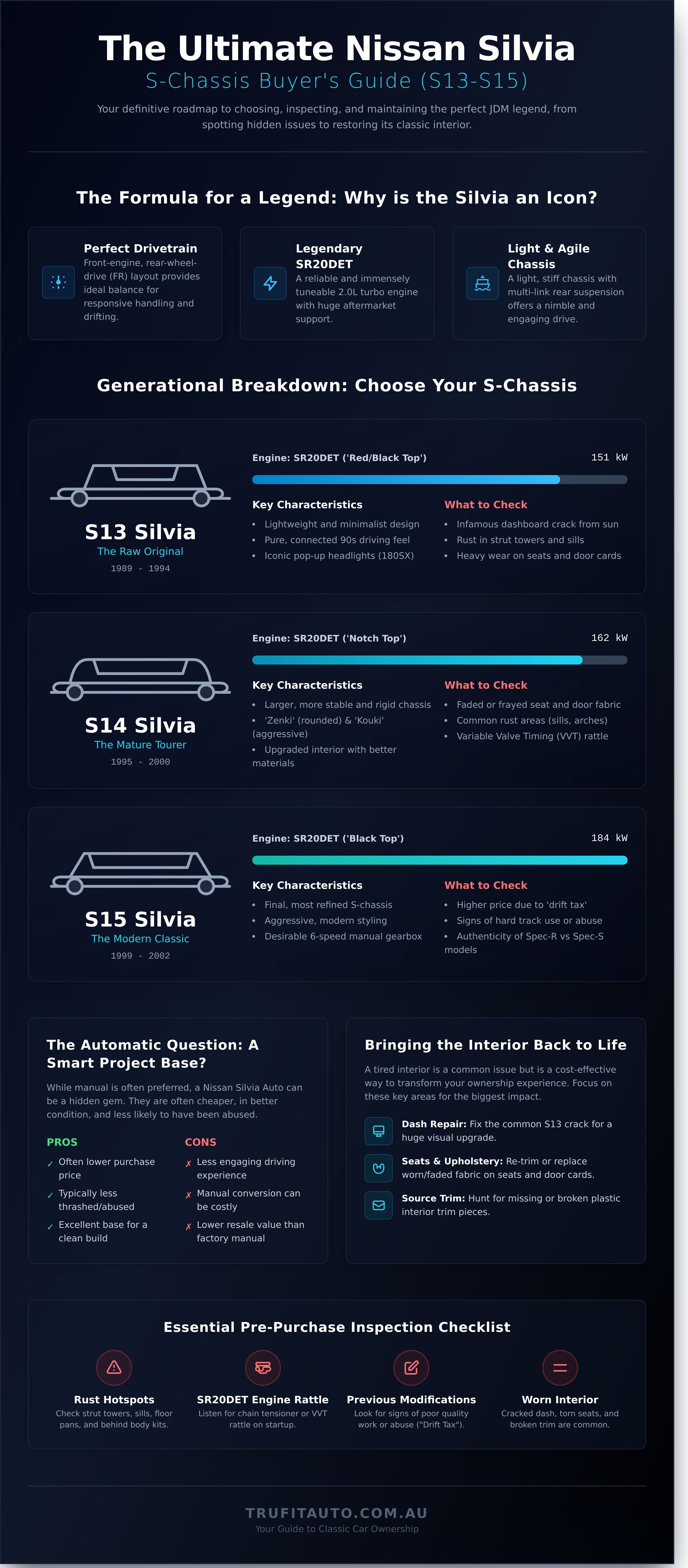
The Nissan Silvia's legacy in Australia is built on three iconic generations, each offering a distinct experience. Known collectively as the S-chassis, the S13, S14, and S15 each have unique characteristics that appeal to different buyers. Whether you're looking for a raw project car or a modern classic, understanding their differences is the first step. Each generation of the nissan silvia auto platform has its own dedicated following for good reason.
| Model | Production Years | Common Engine (Turbo) | Approx. Power (Stock) |
|---|---|---|---|
| S13 Silvia / 180SX | 1989 - 1998 | SR20DET ('Red Top' / 'Black Top') | 151 kW (205 hp) |
| S14 Silvia | 1995 - 2000 | SR20DET ('Notch Top') | 162 kW (220 hp) |
| S15 Silvia | 1999 - 2002 | SR20DET ('Black Top') | 184 kW (250 hp) |
The S13 is the lightweight, minimalist icon that started it all. Famous for its nimble handling and, on the 180SX hatchback, iconic pop-up headlights, it offers a pure 90s driving feel. Buyers should inspect closely for the infamous 'dash crack' caused by sun exposure and check for rust in the strut towers and sills. The simple, driver-focused interior is prone to wear on the seats and door cards, making a well-kept example a rare find.
The S14 grew in size, offering a more stable and rigid chassis. This generation is split into the pre-facelift 'Zenki' (1995-96) with its rounded styling, and the more aggressive facelift 'Kouki' (1997-00). Its interior was an upgrade, with better materials and a more modern layout. However, the fabric on the seats and door inserts is a common wear point, often becoming faded or frayed over time.
As the final and most refined model, the S15 is the most sought-after. It boasts aggressive, modern styling, a potent SR20DET engine, and the desirable 6-speed manual gearbox. The interior is the most premium of the three, with improved plastics, supportive seats, and unique factory options like the A-pillar boost gauge. Given its value, finding a clean, unmodified nissan silvia auto interior is paramount for collectors and enthusiasts alike.
In the world of classic JDM performance cars, the manual transmission is often seen as the only choice. This is especially true for the Silvia, where the enthusiast community strongly favours a three-pedal setup. However, this common preference creates a significant opportunity for savvy buyers in the Australian market. Automatic models are frequently overlooked, making them more affordable and, crucially, often found in much better original condition than their manual counterparts.
The factory 4-speed automatic transmission found in S13, S14, and S15 Silvias is a robust and reliable unit. For daily driving, commuting in city traffic, or simply enjoying a comfortable weekend cruise, it performs its job perfectly well. It delivers a smooth, predictable experience that makes the Silvia an easy and enjoyable car to live with every day, without the premium price tag.
An automatic Silvia is an excellent choice for a specific type of owner. If you're looking for a stylish daily driver that stands out from the crowd, the auto offers a hassle-free experience. It's also the most accessible entry point into Silvia ownership, often priced several thousand dollars less than a comparable manual. Because they were typically driven less aggressively, these models are far more likely to be unmodified, with straight chassis and well-preserved interiors-a genuine rarity today.
For the hands-on enthusiast, a clean nissan silvia auto is the ultimate blank canvas. Finding an unthrashed, factory-spec automatic car provides the perfect foundation for a high-quality project or weekend track car. A manual gearbox conversion is one of the most common and well-documented modifications for these vehicles, with parts readily available across Australia.
The conversion process typically involves sourcing a kit or individual components:
While it requires mechanical work, starting with a pristine automatic body ensures your project is built on the best possible base, free from the hidden damage and rust that can plague heavily modified manual examples.
While a Silvia's heart is its engine and its soul is in how it handles, the interior is where you, the driver, connect with the machine. After decades of enthusiastic use, it's often the most neglected part of the car. Faded plastics, worn fabrics, and tired carpets can detract from the driving pleasure. Restoring the cabin of your nissan silvia auto is a project that pays dividends in both resale value and pure driver satisfaction, transforming every journey into a special occasion.
The foundation of any interior refresh is the flooring. Over the years, your Silvia's original carpet has likely seen it all: coffee spills, stains, mouldy smells, and holes worn through by your heel. The single best way to reset the clock is with a new, pre-moulded carpet. Unlike generic rolls, moulded carpets are specifically shaped for the S13, S14, or S15 floor pan, ensuring a perfect, factory-like fit without wrinkles or bunching. For dedicated track or drift cars, heavy-duty moulded vinyl offers a practical, easy-to-clean alternative. Find the perfect moulded carpet for your Silvia model.
Let's be honest: cars from the 90s lack the sophisticated sound insulation of modern vehicles. Road noise, tyre roar, and exhaust drone can be fatiguing on longer drives. Before laying your new carpet, it's the perfect opportunity to install sound-deadening material. This significantly reduces unwanted vibrations and noise, creating a quieter, more comfortable cabin. The result is a more premium feel, improved audio quality from your stereo, and a much more pleasant driving experience overall.
You've invested in a pristine new floor; the final and most crucial step is to protect it. Throwing in a set of generic, one-size-fits-all mats is a false economy. They slide around under the pedals, fail to cover the high-wear areas, and cheapen the look of your refreshed interior. Custom-fit floor mats are designed specifically for your Silvia's footwells. They lock into place, provide edge-to-edge coverage, and protect your new carpet from dirt, moisture, and wear from day one. For maximum protection against mud and spills, consider a set made from heavy-duty rubber.
Owning a Nissan Silvia is a rewarding experience, but like any classic performance car, it comes with a specific set of potential issues. Whether you're inspecting a potential purchase or giving your own car a health check, a thorough inspection is non-negotiable. At Tru-Fit Carpets by Vision Auto, we believe a well-maintained car starts from the ground up, so we've compiled this practical checklist of the most frequent and costly problems to watch for.
The heart of the Silvia, the SR20DET engine, is robust but requires attention. When inspecting any nissan silvia auto model, particularly S14 and S15 variants, listen carefully on startup. A prominent rattle that quickly disappears could signal a worn VCT solenoid-a common but fixable issue. More serious problems to look for include:
Decades on Australian roads can take their toll on a car's chassis. Rust is the Silvia's biggest enemy, and it often hides in plain sight. A pre-purchase inspection should always involve getting the car on a hoist, but you can check several key areas yourself. Also, look for inconsistent panel gaps, mismatched paint, or overspray in the engine bay, which are tell-tale signs of previous accident damage.
Key rust-prone areas to inspect closely:
Once you've confirmed a solid, rust-free foundation, protecting it is the next step. A pristine interior starts with high-quality flooring. Ensure your investment is protected with custom-fit moulded carpets and mats from Tru-Fit Carpets by Vision Auto, designed to keep moisture out and preserve your Silvia's value.
Owning a Nissan Silvia is about embracing a rich JDM legacy, whether you choose the raw S13, the balanced S14, or the modern S15. This guide has shown that every generation offers a unique path to performance, and a well-maintained nissan silvia auto can be a fantastic and reliable entry point for any enthusiast. The true secret to an exceptional Silvia, however, lies in diligent maintenance and restoring the details that bring the car back to its former glory-especially a tired, worn-out interior.
The perfect foundation for any interior revival starts from the ground up. Give your S-Chassis the quality it deserves with a flawless replacement that honours its heritage. With over 40 years of manufacturing experience, our proudly Australian made and owned products come with a guaranteed perfect fit for your vehicle. Shop for custom-fit Nissan Silvia carpet and flooring now.
Your ultimate Silvia is within reach. Now go out there and build the icon you've always wanted.
The "best" Silvia depends entirely on your goals. For a raw, affordable project car ideal for drifting, the S13 is a popular choice due to its light weight and huge aftermarket support. The S14 offers a good balance of modern comfort and performance, making it a great all-rounder. For those seeking the most refined performance, modern features, and strong investment potential, the S15 is the top contender, especially in Spec-R trim with its 6-speed gearbox.
A well-maintained and relatively standard Nissan Silvia can be a reliable daily driver. The SR20DET engine is known for its robustness. However, these are performance cars that are now decades old. Reliability hinges on previous ownership, regular servicing, and the extent of modifications. Unmodified examples are rare, so a thorough mechanical inspection is essential before purchase. Expect to perform preventative maintenance on aging components like wiring, hoses, and bushings to ensure dependability for daily use.
Prices for Nissan Silvias in Australia vary significantly based on model, condition, and modifications. Expect to pay between A$20,000 to A$35,000 for a clean S13 or S14. The highly sought-after S15s command a premium, with prices for good examples typically starting at A$40,000 and climbing well over A$60,000 for pristine, low-kilometre Spec-R models. These prices reflect the car's iconic status and high demand within the enthusiast community.
Finding parts for any Nissan Silvia auto project is generally straightforward. Mechanical components, especially for the SR20 engine, are widely available thanks to a massive global aftermarket. Performance upgrades and service items are easy to source from Australian suppliers. However, specific interior trim pieces, pristine body panels, and factory-original parts for older models like the S13 can be more challenging and costly to find. Joining owner's clubs and forums is a great resource for tracking down rare components.
The S15 Silvia's high price is due to several factors. It's the final and most technologically advanced generation, featuring a more rigid chassis, a 6-speed manual gearbox in the Spec-R, and a more powerful engine from the factory. Its iconic styling and "hero car" status have driven up demand significantly. Furthermore, being the newest model means cleaner, lower-mileage examples are more common but also more desirable, cementing its position as a premium modern classic in the JDM market.
Yes, installing quality sound deadening makes a significant difference in a Silvia's cabin comfort. These cars were not built with luxury in mind, so road noise, tyre roar, and exhaust drone are very noticeable. Applying sound deadening material to the floor, doors, and firewall dramatically reduces these unwanted vibrations and noises. This creates a quieter, more pleasant driving experience and allows you to better enjoy your audio system, making it a worthwhile upgrade for any daily-driven or touring build.
 To Order Free Call 1800 335 896
 Cart
Cart


